Manufacturing · Finance & Investment · faridabad · Auto Components
The Factory That Discovered Its True Value
How a Faridabad auto components manufacturer built investor-ready documentation — and realised the business was worth more than they thought.
₹2.5Cr
Bank loan sanctioned
₹5Cr
PE investment interest
25Yrs
Business — finally understood
------- The Situation
A healthy, 25-year business. A bank that couldn't see its value.
Faridabad has one of India's largest concentrations of auto component manufacturers. Sharma ji runs a 25-year-old unit making sheet metal components — brackets, housings, and structural parts for two-wheeler and four-wheeler OEMs. His son had recently joined the business after completing engineering and MBA, and was pushing for expansion into EV components.
The bank's hesitation was understandable. The company was profitable — but the documentation was a mess. Revenue was clear, but costs were jumbled. No proper P&L analysis. No cash flow projection. No growth roadmap. The business was healthy. The paperwork didn't show it.

We want to add a new production line for EV components. But we need ₹3 crore for machinery. The bank says our current financials don't support that much loan. We're stuck.
— Sharma ji's son, Faridabad
------- The Real Problem
Banks and investors don't fund businesses. They fund stories backed by data.
Many factory owners run their business from memory and instinct. They know roughly what's coming in and going out. But ask for a 5-year revenue trend, a margin analysis by product line, or a customer concentration breakdown — and they're lost.
01
Organised Data
Revenue was clear, but costs were jumbled. No proper P&L analysis. No way to show a banker which product lines drove profit and which didn't.
02
Forward Projections
No 5-year forecast. No defensible assumptions. No articulation of the EV opportunity. The opportunity existed — it just couldn't be communicated.
03
Years of Value Hidden
Long-term OEM relationships, steady margins, low customer churn. All real strengths — but none visible in a format a banker or investor could read.
------- What We Did Together
Eight weeks. A complete financial and business documentation package.
1
Clean Up Historical Data
Five years of P&L, properly categorised — revenue by customer, by product type; costs broken into raw material, labour, overheads, and finance. For the first time, Sharma ji could see exactly where money was coming from and going to.
2
Analyse Profitability
Which products made money? Which customers were most valuable? What was the trend? The numbers revealed that two product lines were far more profitable than others — but Sharma ji had been treating all products equally for years.
3
Build Projections
Based on existing customer growth, new customer pipeline, and the EV opportunity — a realistic 5-year forecast was created. Not fantasy numbers. Defensible projections backed by concrete, documented assumptions.
4
Create the Business Case Document
Executive summary, market opportunity, competitive advantages, financial history, projections, funding requirement, use of funds, and risk factors. Everything a banker or investor would want to see — in a format they were used to.
5
Set Up Ongoing Tracking
A simple monthly dashboard: revenue, margins, cash flow, receivables, key customer status. So this level of visibility would continue permanently — not just for the bank visit.
------- The Results
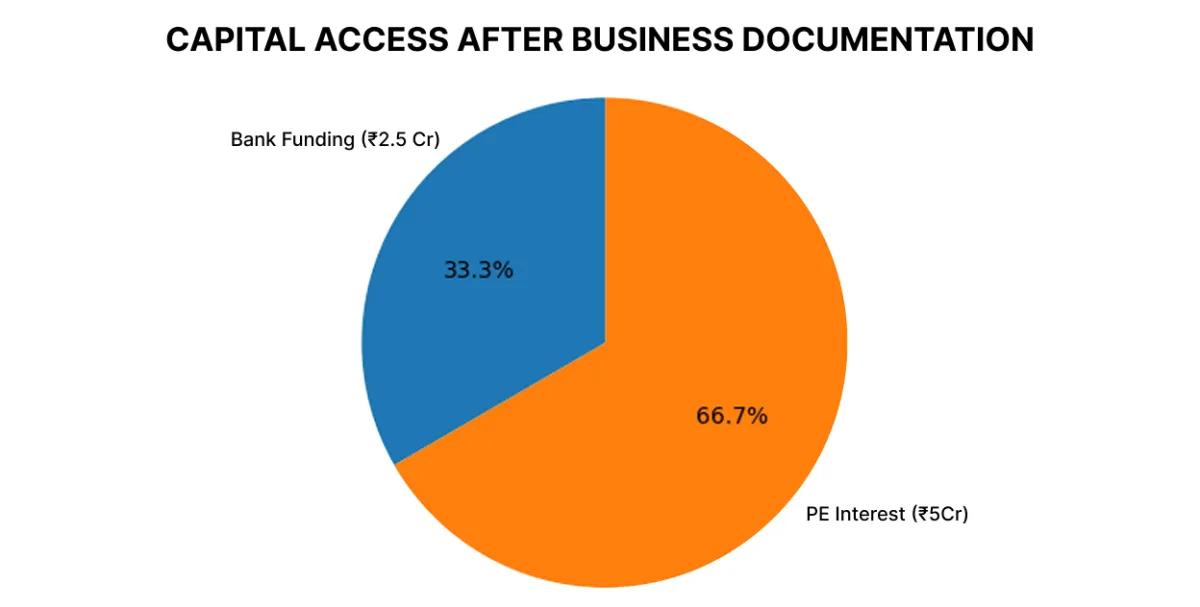
₹2.5 crore sanctioned. ₹5 crore PE interest. Options they never had before.
6 Wks
To loan sanction
₹2.5Cr
Loan at favourable terms
₹5Cr
PE minority stake interest
2+
Funding options created
Armed with the documentation, Sharma ji's son went back to the bank. This time, the conversation was different. The bank could see the business clearly - the stability, the margins, the opportunity. Within 6 weeks, they sanctioned Rs. 2.5 crore at favorable terms.
But something else happened that they didn't expect. A private equity fund focused on auto components reached out - they had heard about the EV expansion plans through an industry contact. After reviewing the documentation, they expressed interest in investing Rs. 5 crore for a minority stake.
Sharma ji is still evaluating that offer. But the point is: he now has options. He's no longer just a factory owner hoping for a bank loan. He's a business owner who knows his value and can articulate it clearly.
