Manufacturing · D2C Launch · Surat · Textiles
The Textile Unit That Launched Without Burning Lakhs
How a Surat fabric manufacturer built a D2C saree brand from scratch — with a small budget and zero VC funding.
₹5L
Total budget
₹85
Acq. cost/customer
₹12L
Monthly at 1 year
------- The Situation
2,000 sarees a day. All of it to wholesalers at wafer-thin margins.
Surat is the textile capital of India — producing over 30 million metres of fabric every day. But most factories here are invisible to end consumers. They supply fabric to wholesalers, who supply to retailers, who supply to local shops. Mehta saab's medium-sized unit makes synthetic sarees — georgette, chiffon, and crepe — and every piece flows into that same wholesale chain.
His daughter Priya returned after her MBA with a clear vision: launch a D2C brand. She had seen what Nykaa Fashion and Libas had built. She knew her factory made the same products — just without the marketing. But the numbers were intimidating.

They're selling the same products we make, just with better marketing. Why can't we do that?
— Priya, Mehta saab's daughter, Surat
The brands Priya admired had raised crores in funding, spending lakhs every month on Instagram ads and influencer collaborations. Priya had ₹5 lakh total — not monthly, total. Her father wasn't willing to bet more on an experiment.
------- The Real Problem
She didn't need to compete on their terms. She needed a different game.
Big D2C brands spend heavily because they're trying to reach everyone. Broad targeting, generic messaging, compensated with volume. But a factory doesn't need a million customers. It needs a thousand loyal ones.
The answer wasn't to out-spend the funded brands. It was to find a narrower segment, serve it with precision, and build from there — using channels that cost almost nothing.
01
Focus
Not 50 products for everyone — 12 products for one specific segment. Working women in Tier-2 cities who need elegant, affordable sarees for office and occasions.
02
Positioning
"Factory-fresh sarees at wholesale prices — no middlemen, no markups." The factory origin wasn't hidden. It was the entire selling point.
03
Channel
Not Instagram ads. WhatsApp — where Priya already had real relationships. Personal outreach, word of mouth, and a simple referral loop built on trust.
Solving for access and trust without asking mechanics to change their habits became the core design challenge of the entire system.
------- What We Did Together
A lean brand. A lean system. Zero wasted spend.
Two days at the factory and office. Priya had already done some homework — a brand name, logo concepts, positioning ideas. But she was trying to do everything at once. The first job was to narrow, not expand.
01
Narrow the Focus
From 50 products to 12. From "women who buy sarees online" to one clear segment: working women in Tier-2 cities needing elegant, affordable sarees for office and occasions. Specificity over reach.
02
Brand Foundation
A simple, distinctive visual identity. Clear positioning built around the factory advantage — not hidden from it. The manufacturing origin became the core story, not an afterthought.
03
Lean Shopify Store
12 products. Smartphone photography with basic lighting. Product descriptions focused on fabric, occasions, and care instructions. Clean, fast, functional — not flashy.
04
WhatsApp Launch
Priya personally messaged 500 women from her contacts and college alumni network, offering a "friends and family" launch discount. She asked each buyer to share in their WhatsApp groups. No ad budget spent.
05
Referral Program
Share a code with friends, get ₹100 off your next order for each friend who buys. No app, no complicated tracking — just a Google Sheet Priya managed manually. Simple enough to actually work.
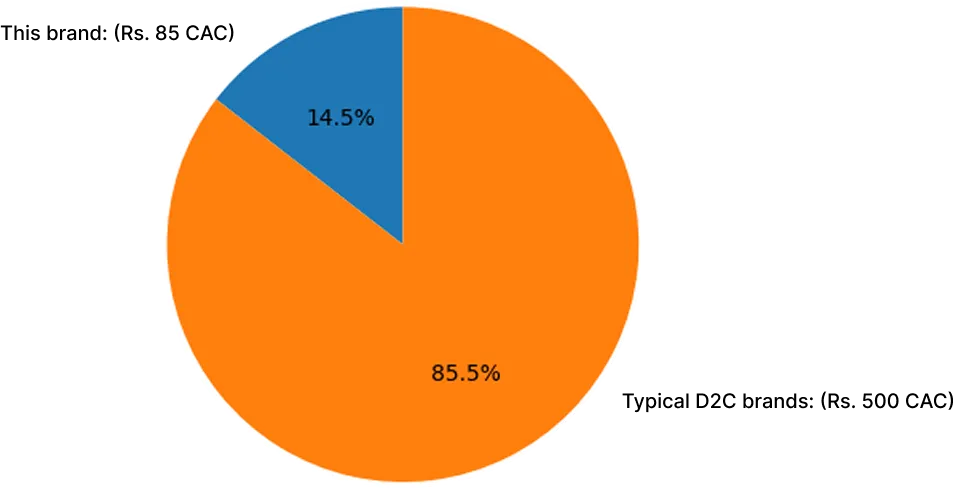
Customer Acquisition Cost comparison
------- The Results
87 orders in 30 days. Zero spent on ads.
87
Orders in first 30 days
312
Orders by day 90
1400
WhatsApp broadcast list
₹85
Customer acq.
cost
Total spend in the first 90 days: under ₹80,000 — mostly on the website, basic photography, and packaging. No influencers. No celebrity endorsements. No crores in funding. Customer acquisition cost was ₹85, compared to ₹400–600 for typical D2C brands.
One year later, the brand does ₹12 lakh per month. Priya runs it full-time with a small team. Mehta saab's factory dedicates about 5% of capacity to the D2C brand — but that 5% generates higher margins than the other 95%.
More importantly, Priya now has something no wholesaler can offer her father: proof that their products have consumer demand. That's leverage — in negotiations, in pricing, in every decision about the factory's future.