Manufacturing · Sales System · Tirupur · Knitwear
The Inquiry System That Was Leaking Money
How a Tirupur knitwear factory doubled their order conversion by fixing a broken follow-up system — without spending more on leads.
8%→19%
Conversion rate
₹25L
Monthly revenue
60 days
To see results
------- The Situation
40–50 inquiries a month. Only 4–5 converting into orders.
Tirupur is India's knitwear capital — exporting over ₹30,000 crore worth of garments every year. Senthil sir runs a mid-sized unit here — about 200 workers, specialising in men's polo t-shirts. He had recently started getting inquiries from smaller domestic brands and boutique retailers through IndiaMART and his basic website.
The inquiries were coming. The orders weren't. And no one could explain why.

These people are reaching out to us — they're interested. Why don't they buy?
— Senthil sir, Knitwear Manufacturer, Tirupur
When asked how they handled inquiries, the answer was simple: inquiries came to a shared email, someone forwarded them to the salesperson, who called when he had time. Sometimes that was the same day. Sometimes it was a week later. There was no system. No tracking. No follow-up process. Inquiries disappeared into a black hole.
------- The Real Problem
The leak wasn't in the leads. It was in what happened after.
I asked Senthil sir to show me the last 3 months of inquiries. We found 127 total inquiries. Of these, only 68 had been called back. Of those 68, only 23 had received a follow-up after the first call. Of those 23, 11 had converted.
01
60%
Never called back
59 of 127 interested buyers never received a single callback. Money spent generating those inquiries — completely wasted.
02
80%
No proper follow-up
Of those who were called, only 23 ever received a follow-up call. Most conversations simply ended with no next step.
03
0
Tracking in place
No system, no data, no visibility. Owners spent on IndiaMART and trade fairs to generate leads — then let most of them vanish.
This is a hidden problem in many factories. Owners focus on production — that's what they know. Sales runs on auto-pilot, often badly. No one measures it, so no one fixes it.
------- What We Did Together
Five fixes. Same number of leads. More than double the orders.
Three days in the office — not the factory floor — watching how inquiries flowed, how calls were made, what happened after each conversation. Seven places where inquiries were leaking. Five fixes to seal them.
1
Map the Entire Inquiry
From the moment someone fills a form on IndiaMART to the moment they place an order — or don't. Every step documented, every gap identified. Seven leakage points found across the process.
2
Build a Simple Tracking System
Nothing fancy — a Google Sheet with columns for inquiry date, source, contact details, first call date, call outcome, follow-up date, and status. Every inquiry logged. Every call recorded with notes. No inquiry could disappear anymore.
3
Create Response Standards
Every new inquiry called within 4 hours. If no answer — call again in 24 hours. If contact is made — send a WhatsApp catalog and pricing within 2 hours. Follow up at 3 days, 7 days, then 14 days. Written. Enforced. Measured.
4
Train the Salesperson Properly
A good talker with no structure. A simple call script was built: understand their requirement, explain capabilities, address concerns, propose next steps. Common scenarios were role-played until confidence was solid and consistent.
5
Hire One More Person
The existing salesperson couldn't handle 50 inquiries plus his other work. A young graduate was brought in with one job: make first calls and qualify inquiries. Serious buyers went to the senior person. Casual inquiries were nurtured through WhatsApp.
------- The Results
8% to 19% conversion. Same leads. More than double the orders.
8%→19%
Conversion rate in 60 days
2×+
Monthly orders
₹25L
Monthly channel revenue
3×
Revenue vs. starting point
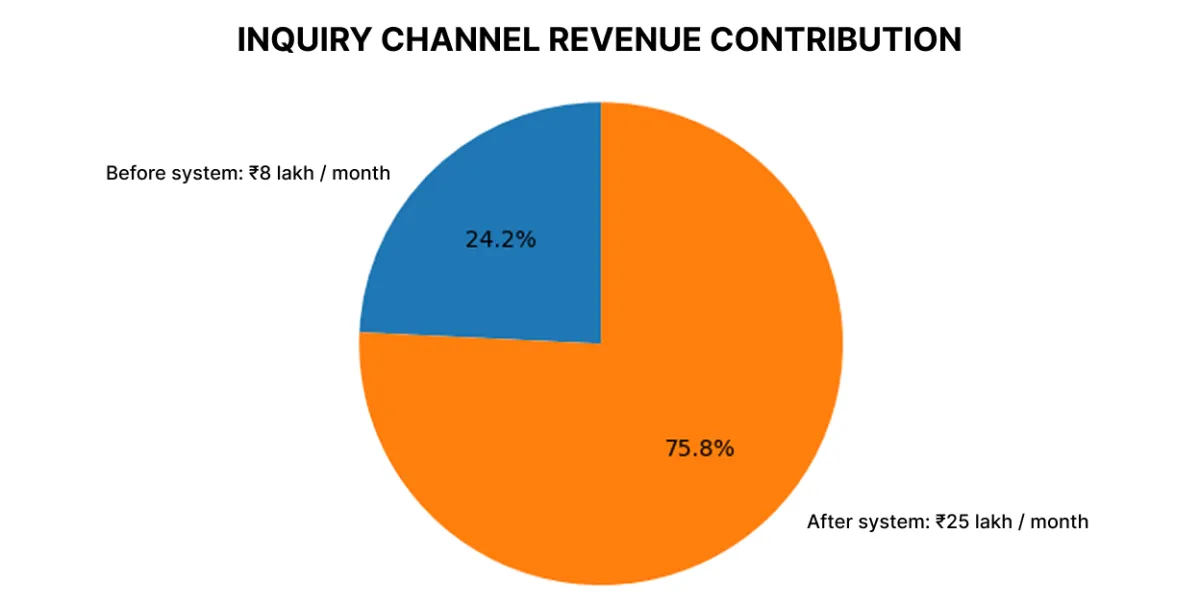
Within 60 days, conversion went from 8% to 19% — more than double — with the same number of incoming inquiries. Monthly orders from the inquiry channel went from 4–5 to 9–10. Average order value also increased, because proper follow-up meant discussing larger requirements that rushed calls had missed.
Six months later, the junior hire had become skilled enough to handle most conversations independently. The senior salesperson now focuses only on large accounts and relationship building. The inquiry channel contributes ₹25 lakh per month — up from ₹8 lakh when we started.
But the biggest change was visibility. Senthil sir can now see exactly what is happening with every single inquiry — spot delayed callbacks, missed follow-ups, and inquiry types that never convert. The business is no longer running blind.