Manufacturing · Sales System· Jamnagar · Brass Fittings
The Sales Team That Was Running Blind
How a Jamnagar brass fittings factory built a proper sales system — and stopped losing deals they should have won.
+28%
Sales in 6 months
−30%
Travel costs
847
Prospects mapped
------- The Situation
6 sales people. 3 states. No system. No visibility.
Jamnagar is known for brass parts and fittings. Factories here supply to plumbing, automobile, and industrial sectors across India. Bhavesh bhai runs a unit making precision brass fittings — connectors, valves, and custom components for industrial applications. He had 6 salespeople covering Gujarat, Maharashtra, and Rajasthan.
The sales operation ran on intuition and habit. Territories were based on relationships from a decade ago. Targets were last year's numbers plus 15%. Pricing had "some flexibility" but no clear guidelines. Nobody measured anything, so nobody could improve anything.

I don't know what my sales team does all day. They travel, they meet people, they come back with orders sometimes. But I can't tell you why one person gets more orders than another.
— Bhavesh bhai, Brass Fittings Manufacturer, Jamnagar
The salespeople weren't bad at their jobs. They were operating without any structure or support. No one had ever mapped the market properly. No one had defined what "good" looked like.
------- The Real Problem
The problems weren't hidden. They were everywhere — just unmeasured.
A week on the ground — traveling with salespeople, attending their meetings, reviewing past deals — made it clear that the sales operation had multiple simultaneous failures.
01
120km
Wasted Travel
One salesperson drove 120 km to visit a ₹15,000/month client while ignoring 8 potential accounts just 20 km from the factory.
02
4X
Unequal Territories
One territory had 200 potential units. Another had 50. Both people had the same target — making one job impossible and the other effortless.
03
0
Pricing Consistency
The same product sold at different rates to similar customers — depending on which salesperson handled the account. No framework, no guardrails.
------- What We Did Together
Same team. Same products. Same market. A completely new system.
Three months rebuilding the sales operation from the ground up — not by hiring new people or buying expensive software, but by creating proper systems and frameworks.
1
Market Mapping
Using industry directories, trade association data, and the team's own knowledge, we created a database of every potential customer across 3 states. Total: 847 industrial units that could potentially buy brass fittings — most of them never contacted before.
2
Territory Redesign
Territories rebuilt based on geography (minimising travel time), potential (balancing opportunity across salespeople), and existing relationships. Each person now had a clear territory with a defined account list to pursue.
3
Proper Target Setting
Instead of "last year plus 15%," targets were calculated based on territory potential. A territory with 150 industrial units and ₹40,000 average order value got a different target than one with 80 units and ₹25,000 average.
4
Pricing Framework
Standard prices, volume discounts, and approved discount limits created for each product category. Salespeople could now quote confidently without calling the factory for every deal.
5
Input-Based Reviews
Instead of asking "how much did you sell," we asked "how many new accounts did you visit, how many quotes sent, how many follow-ups done." Track inputs, not just outputs. Behaviour changes when you measure the right things.
------- The Results
28% more sales. 30% less travel. Same team.
2X
New account acquisition
-30%
Travel costs
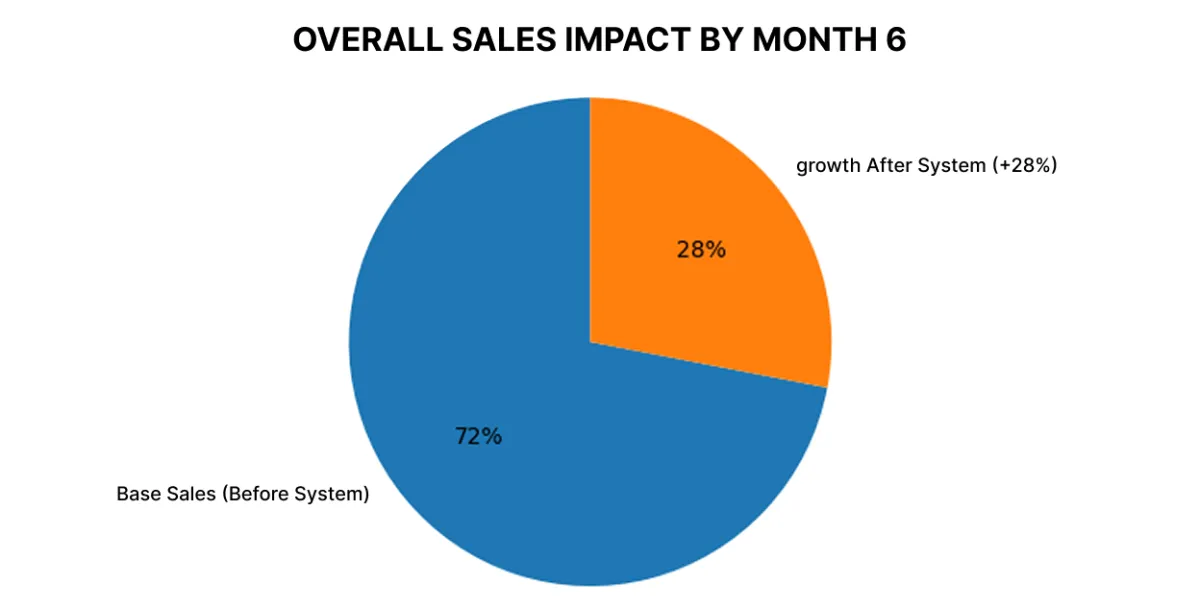
+28%
Overall sales at 6 months
0
New hires needed
The impact wasn't immediate — building systems takes time. But by month 4, the numbers started moving. New account acquisition doubled as the team systematically pursued the mapped prospects instead of randomly visiting whoever they felt like. Win rates improved as clearer pricing meant fewer deals lost to confusion or inconsistency.
Travel costs dropped 30% as sensible territories eliminated wasted road time. Salespeople were making more client visits in less time. By month 6, overall sales were up 28% — with the same team, same products, same market.
