Manufacturing · Marketplace SEO · Panipat · Home Textiles
The Factory That Was Invisible on Marketplaces
How a Panipat home textiles manufacturer went from page 5 to page 1 on Amazon — and increased orders by 150% in 45 days.
+150%
Daily orders
4.2★
Rating (from 3.6)
₹8L
Monthly revenue
------- The Situation
45 products listed. 3–4 orders a day. Invisible in plain sight.
Panipat is India's textile recycling and home furnishing hub — producing blankets, rugs, cushion covers, and home textiles sold across the country. Vinod ji runs a unit making cotton bedsheets and cushion covers. Two years ago, his son had set up listings on Amazon and Flipkart, hoping to tap into the e-commerce boom.
The products were live. The orders weren't coming. And Vinod ji could see other sellers — some of them buying from factories exactly like his — generating hundreds of orders daily.

We have 45 products listed. But we get maybe 3–4 orders a day. I see other sellers getting hundreds of orders. What are they doing that we're not?
— Vinod ji, Home Textiles Manufacturer, Panipat
When the listings were examined, the problem was obvious. Poor photos taken against a factory wall. Generic titles like "Cotton Bedsheet Double Bed." No proper descriptions, wrong keywords, and pricing that didn't account for marketplace fees. They were on the platform — but completely invisible.
------- The Real Problem
Marketplace logic is different. The algorithm decides who gets seen.
Vinod ji's son had treated Amazon like a catalog — just upload products and wait. But that's not how marketplaces work. The algorithm rewards listings that are properly optimised; everything else gets buried under thousands of competitors.
01
Photos
Factory-wall phone shots. No white background, no lifestyle imagery. Low click-through rate meant the algorithm buried them further with every passing day.
02
Keywords
Generic titles meant no discoverability. The search algorithm had no signal to surface their listings when buyers searched for specific product attributes.
03
Pricing
Prices didn't account for marketplace fees, shipping, and returns. 8 products were actively losing money on every sale — without anyone realising it.
The successful sellers Vinod ji envied weren't selling better products. They had simply figured out the marketplace game — keywords, photography, pricing, and reviews working together as a system.
------- What We Did Together
Two months. 45 listings. A complete overhaul — no new products needed.
Instead of adding more products, everything was focused on fixing what already existed. Competition was studied, listings were rebuilt, and a review system was created from scratch.
1
Analyse the Competition
Studied the top 20 sellers in their category on Amazon. What keywords were they using? How were their photos styled? What price points were working? What did their reviews say? Success was reverse-engineered before a single change was made.
2
Fix the Product Photos
A local photographer was hired for one day. All 45 products were shot against white backgrounds, with lifestyle shots showing the bedsheets on actual beds. Total cost: ₹8,000. The difference was night and day.
3
Rewrite Every Listing
Titles with proper keywords: "100% Cotton Double Bedsheet with 2 Pillow Covers — 300 TC — Floral Print — King Size 90×100 inches." Bullet points highlighting fabric quality, thread count, wash care. Descriptions that answered common customer questions before they were asked.
4
Restructure Pricing
Actual costs calculated including marketplace fees, shipping, and returns. Prices set to be competitive but profitable. 8 products identified that were losing money on every sale — prices raised or listings discontinued.
5
Restructure Pricing
Actual costs calculated including marketplace fees, shipping, and returns. Prices set to be competitive but profitable. 8 products identified that were losing money on every sale — prices raised or listings discontinued.
------- The Results
Page 5 to page 1. 3 orders a day to 8–10. In 45 days.
45 days
To page 1 rankings
+150%
Daily orders
3.6→4.2
Average rating
₹8L
Monthly revenue at 6 months
Within 45 days, the top 10 products had moved from page 4–5 to page 1–2 for their main keywords. Orders went from 3–4 per day to 8–10 — a 150% increase. More importantly, profit per order increased because pricing was now correct.
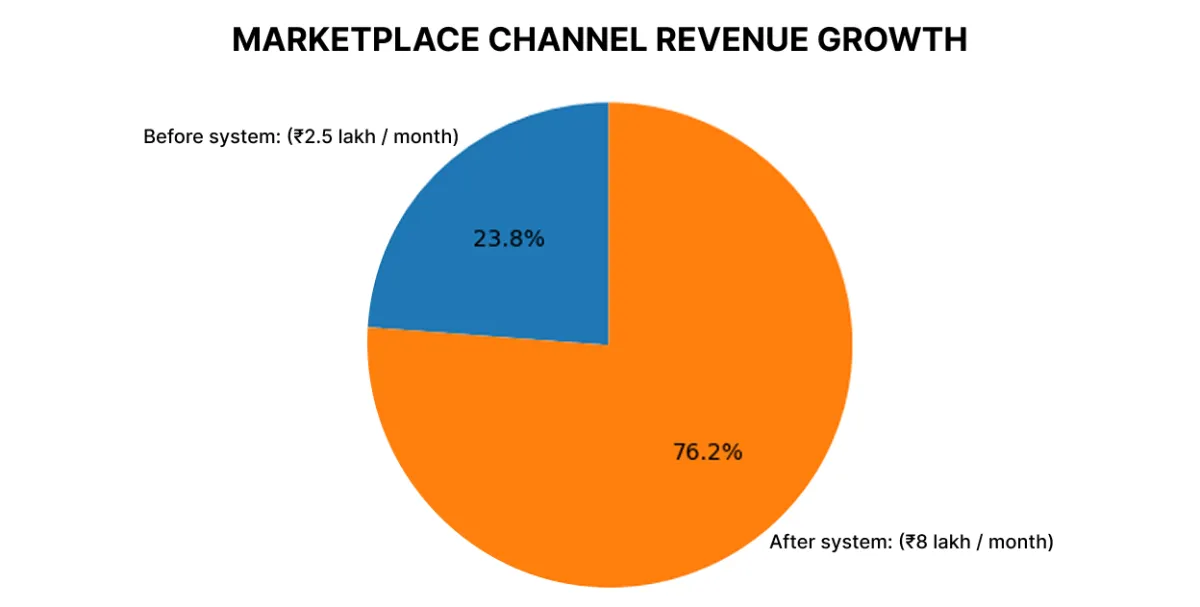
Reviews improved dramatically. The follow-up system caught unhappy customers early; better photos meant fewer "product looks different" complaints. Average rating went from 3.6 to 4.2 stars. Six months later, the marketplace channel does ₹8 lakh per month, up from ₹2.5 lakh.
Vinod ji's son now manages the marketplace business full-time. He reads the data, tests new products, and optimises continuously. The factory has a digital storefront that works.