Manufacturing · Pricing Strategy · Surat · Diamond Polishing
The Pricing Puzzle That Was Costing Crores
How a Surat diamond polishing unit discovered they were undercharging some customers and overcharging others — and fixed it with data.
+8%
Margin per job
20%→35%
Win rate on new inquiries
4 hrs
Quote time (from 2–3 days)
------- The Situation
Every customer gets a different rate. It's all in my head.
Surat handles 90% of the world's diamond polishing. Hasmukhbhai runs a medium-sized polishing unit — about 150 workers, doing contract work for exporters and domestic jewellers. His pricing had evolved over 20 years of negotiations, relationships, and gut feeling.
Old customers got loyalty discounts. Big orders got volume discounts. New customers got quoted based on how much the business was wanted. No framework, no consistency, no data. And when asked which customers were actually profitable — the answer was a confident assumption that turned out to be dangerously wrong.

Every customer gets a different rate. Old customers get loyalty discounts. New customers — we quote based on how much we want their business. It's all in my head.
— Hasmukhbhai, Diamond Polishing Unit, Surat
------- The Real Problem
Of 45 customers: 12 were profitable. 18 were marginal. 15 were losing money.
A week of customer data analysis — order history, pricing, payment terms, rework requests, and actual costs for different job types — revealed the uncomfortable truth.
01
15
Loss-making customers
The "best" customers by volume had negotiated the lowest rates and demanded the most rework — making them the least profitable of all.
02
20%
Quote win rate
Without a clear rate card, every quote was a negotiation. Serious buyers often went elsewhere because they couldn't get a straight, fast answer.
03
2–3d
Time to quote
Small customers who paid standard rates and never complained were the most profitable — but they were being neglected because they didn't seem "important."
------- What We Did Together
Six weeks. A pricing framework built on data, not memory.
Two days on the factory floor — not in the office — revealed a real product advantage: a brushed cotton blend softer and more breathable than the synthetic thermal wear most brands sell. Workers in cold environments loved it. That story had never been told.
1
Calculate True Costs
Different diamond sizes and cuts require different amounts of time and skill. Actual labor hours, machine time, and material consumption were measured for each job category. For the first time, the real cost of every job type was known.
2
Build a Pricing Matrix
Standard rates for each job type, with defined discount slabs for volume — 10% for orders above X, 15% for orders above Y. No more random negotiations. Everyone quoted from the same framework, consistently.
3
Address Unprofitable Customers
Not dropped immediately — honest conversations first. "Our costs have increased. Here's our new rate. We value your business and hope to continue." Some accepted. Some left. The ones who left were a relief — the business stopped losing money on them.
4
Create a Simple Quoting Tool
An Excel sheet where the office could enter job specifications and instantly generate a quote. New inquiries got responses in hours instead of 2–3 days. Professional, consistent, fast — and the win rate on new inquiries improved immediately.
------- The Results
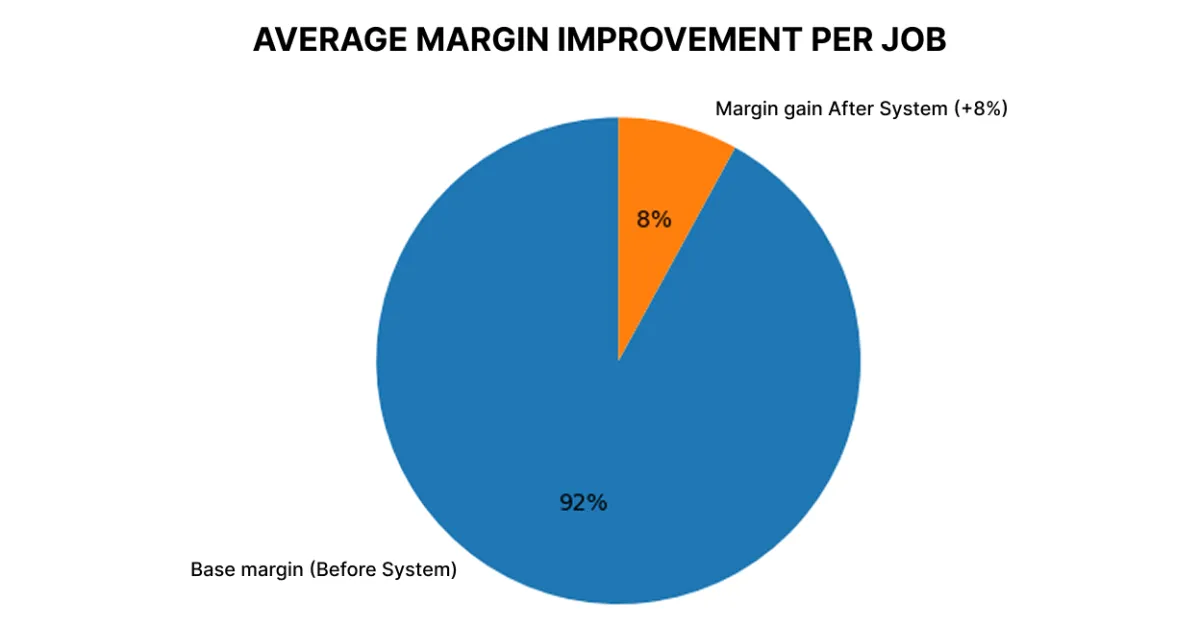
+8% margins. 20% to 35% win rate. Quotes in 4 hours, not 3 days.
+8%
Avg. margin per job
20%→35%
New inquiry win rate
4 hrs
Quote turnaround
4 months
To full results
Within 4 months, average margin per job increased by 8%. Revenue stayed roughly the same — some volume was lost from price-sensitive customers, but it was gained back from new customers attracted by the professional, fast quoting process.
Quoting time dropped from 2–3 days to 4 hours. Potential customers who needed quick responses no longer went to competitors. Win rate on new inquiries improved from 20% to 35%.
